Hem / Nybörjare / Branschnyheter / How to Use Men's Compression Socks for Swollen Ankles: Fit, Timing, and Everyday Wear
How to Use Men's Compression Socks for Swollen Ankles: Fit, Timing, and Everyday Wear
A sock line that is still pressed into your ankle at six in the evening is not a laundry problem. It usually means fluid has pooled in your lower leg during the day, and the fix is not a looser sock. It is a sock that puts the right amount of pressure in the right place at the right time.
Here is the short answer for men dealing with swollen ankles. Choose a measured calf-length or knee-high compression sock in the 15 to 20 mmHg range for everyday puffiness, put it on before you stand up in the morning, and wear it for 8 to 12 hours. Low-cut ankle socks and tight everyday socks rarely solve the problem, because graduated pressure has to be spread along the leg rather than squeezed into a single band above the ankle bone.
Why Compression Helps a Swollen Ankle
Compression socks work on a principle called graduated pressure. The strongest pressure sits at the ankle and gets weaker as the fabric climbs toward the knee. That gradient supports the veins and the calf muscle pump, the natural mechanism that pushes fluid back toward the heart. Without that support, fluid collects around the ankle bone through the day, and the swelling is usually at its worst in the late afternoon.
Length matters for the same reason. A low-cut sock creates one narrow zone of pressure, while a calf-length sock spreads the gradient across the ankle and the lower leg. For a man whose swelling reaches above the ankle bone, calf length is the practical minimum, and knee-high is often the better choice on days with long sitting, long standing, or air travel.
This is also why an ordinary dress sock feels wrong even when it fits. Everyday socks are knitted to stay up, not to create a pressure gradient, so they squeeze hardest at the top band. That is the opposite of what a swollen ankle needs.
Match the Compression Class to Your Swelling
Compression is sold in classes defined by the pressure measured at the ankle in millimetres of mercury. Buying the strongest class on the shelf is a common mistake. More pressure is not the same as more relief, and a class that is too high can leave your toes cold, numb, or tingling by lunchtime.
Compression classes are set by the pressure measured at the ankle in millimetres of mercury, and the pressure is designed to fall as the sock rises up the leg.
Class
Pressure at the ankle
Typical use
Fitting note
Mild support
8 to 15 mmHg
Tired, mildly puffy ankles after long standing or a flight
The easiest class to put on, often sold as a travel sock
Moderate support
15 to 20 mmHg
Everyday ankle swelling, long shifts, post-flight puffiness, mild injury recovery
The usual starting point for men, and it needs a measured calf
Firm support
20 to 30 mmHg
Noticeable swelling and clinician-directed treatment
Needs an accurate measurement and a fit check, not guesswork
Extra firm support
30 to 40 mmHg
Significant swelling and lymphedema, prescribed rather than self-selected
Fitted and supervised by a clinician
For mild to moderate swelling caused by standing, sitting, or travel, the 15 to 20 mmHg class is the usual starting point. If a clinician has already told you to manage more significant swelling, or you are recovering from an ankle injury, follow that instruction rather than the label on the package.
The chart compares how pressure falls along the leg for two common classes of men's compression socks, using the ankle as the reference point. In both classes the ankle receives the full pressure and the numbers drop as the sock climbs toward the knee. In the 15 to 20 mmHg class the ankle sits near 18 mmHg, and the pressure below the knee falls to roughly 7 mmHg. In the 20 to 30 mmHg class the ankle starts near 25 mmHg and still drops to about 10 mmHg below the knee. The pattern matters more than the headline number, because a sock that holds the same pressure all the way up the calf is not graduated compression at all. Notice also that the two classes differ by only a few millimetres of mercury in the upper calf, which is why fit at the ankle decides comfort far more than the class label does.
Measure the Ankle and the Calf Before You Buy
Size charts for compression socks are built on two numbers, ankle circumference and calf circumference. Shoe size is not one of them, and a sock chosen by shoe size alone is one of the most common reasons men abandon compression after a week.
Measure within 30 minutes of waking, before you stand or walk for long.
Wrap a soft tape around the narrowest part of the ankle, just above the ankle bone.
Measure the widest part of the calf, usually about a hand's width below the knee.
Measure from the floor to just below the bend of the knee for the length.
Compare all three numbers with the size chart and follow the calf measurement when the ankle and calf land in different sizes.
Repeat the measurements if your weight changes, or if a clinician changes your treatment.
When the ankle and the calf fall into two different sizes, the calf usually decides, and a band that is too tight at the top is the one place where compression can do real harm. It is also worth remembering that a size chart describes a new sock. Fabric relaxes with washing, so two pairs in rotation will hold their gradient far longer than one pair worn every day. If you are buying for everyday wear rather than a specific prescription, the full range of men's socks is a sensible place to compare lengths and materials before you commit to a class.
Ankle circumference is not a fixed number, and the chart shows a typical pattern for a man who stands and sits through a working day. The measurement is smallest shortly after waking, at about 24.8 cm in this example, and it grows steadily to roughly 27.1 cm by early evening. That is a change of more than 2 cm, which is easily enough to move one man from one sock size into the next on a size chart. It also explains why a pair that feels perfect at 7:00 AM can feel tight and itchy by dinner time. Measuring in the morning gives you the truer and lower number, which is the number the manufacturer expects you to use. If you measure after a long day on your feet, you will very likely order a sock that is too large at the ankle and will not hold its gradient. The gap between the morning and evening figures also gets wider in hot weather, which is worth remembering if you buy a single pair for the whole year.
Put Them On Before Your Feet Touch the Floor
The single habit that decides whether compression works for you is timing. Ankles are smallest in the first 30 minutes after waking, so the sock slides on easily and holds the leg at its baseline instead of pushing fluid upward. Wait until after breakfast and a shower, and you are fitting a sock around swelling that has already started.
A method that works with firm fabric
Turn the sock inside out down to the heel, keeping the foot section intact.
Slide your foot in and check that the heel pocket sits under your heel, not on your instep.
Work the fabric up the leg in short sections with both thumbs instead of pulling the top band.
Stand up, then smooth out any fold or roll before you put your shoe on.
Check your toes for colour and warmth five minutes later, and again at lunchtime.
Wrinkles are the enemy here. A single fold behind the ankle concentrates pressure and can create a sore spot within a few hours, so take an extra 20 seconds to smooth the fabric flat. If you have limited grip or a stiff back, a plastic donning aid or a light dusting of cornstarch on the heel makes the job much faster.
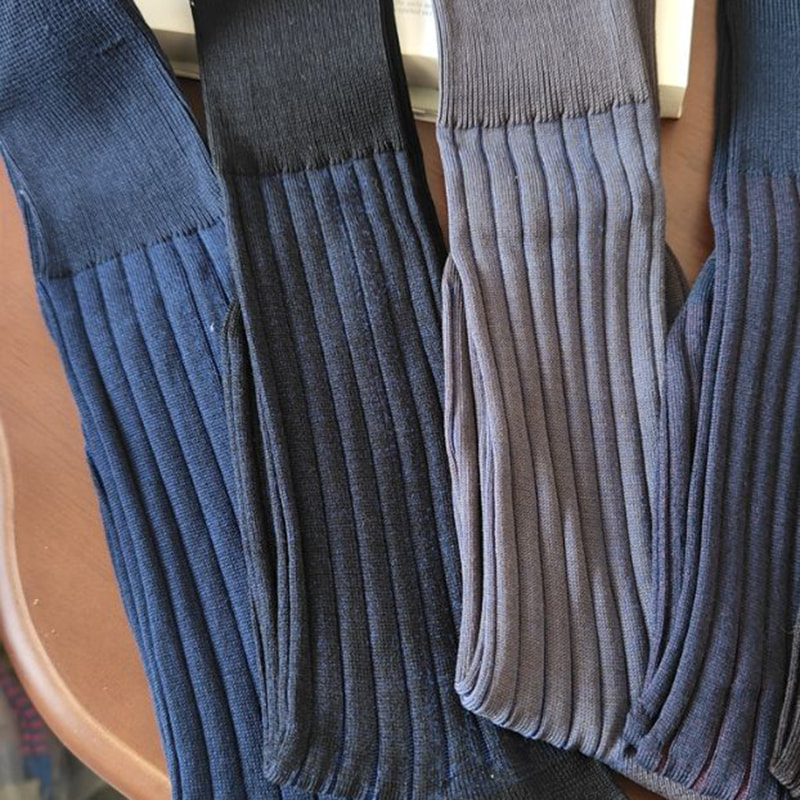
A sock that reaches the calf gives the gradient somewhere to travel. A longer style such as this one is designed for full length coverage over the ankle and lower calf:
Eight to twelve hours is the normal daily window for men's compression socks. That covers a work shift or a long flight but stops short of overnight, because ankles usually drain well enough when you are lying down. Take the socks off before bed unless a clinician has told you otherwise, and put your feet up for 20 minutes in the evening.
On travel days the timing rules tighten. Put the socks on before you leave the house, stand and walk every hour you are awake, and drink water rather than relying on salty airport food. Compression manages pooling, but it does not replace movement.
Wash the socks after every wear in lukewarm water, by hand or on a gentle cycle, and skip both the fabric softener and the dryer. Heat and softener break down the elastane that creates the gradient, so the same habits that extend the life of everyday socks apply here, and a two-pair rotation will outlast a single pair by a wide margin. These care and maintenance habits for men's socks are a good baseline for any sock you plan to wear daily.
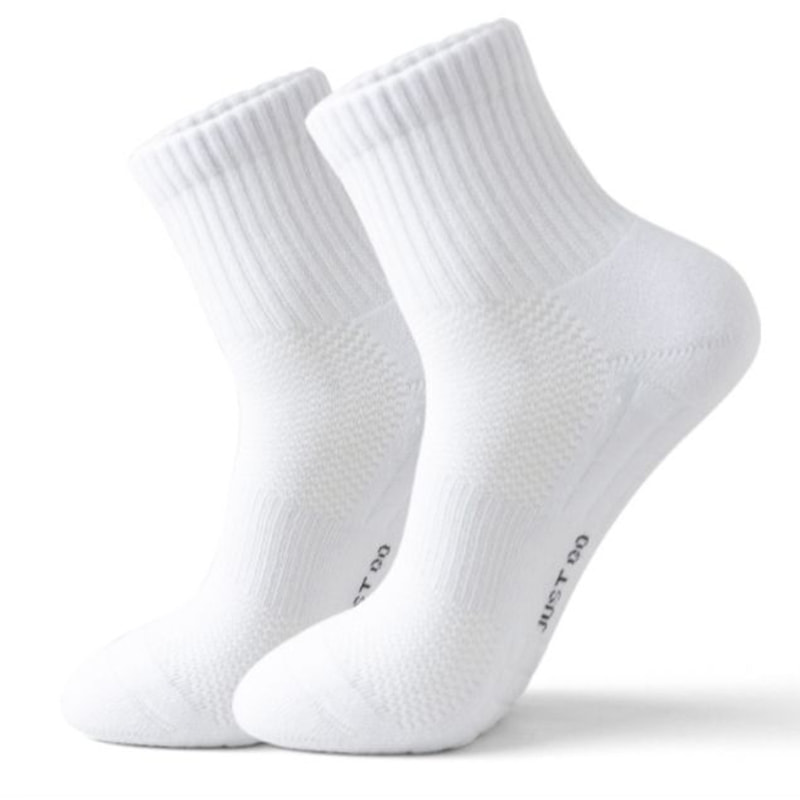
For training days, a sock with a cushioned footbed under a graduated upper is usually more comfortable than a thin medical stocking, especially in shoes that run warm. A towel-bottom sport style like this one handles the sweat and the impact:
Compression is not supposed to feel like nothing. A firm hug around the ankle and a light squeeze at the calf for the first hour is normal, and it usually settles once you start moving. What is not normal is numbness, a burning sensation, or a band that leaves a deep groove which takes more than 30 minutes to fade.
first week of wear, in cm 27.526.525.5Day 1Day 2Day 3Day 4Day 5Day 6Day 7Evening measurement, taken at about 7:00 PM
The line follows evening ankle circumference over the first seven days of consistent morning wear, starting at 27.2 cm and ending near 26.0 cm. The change is not dramatic on any single day, which is exactly why some men quit in the first 48 hours. Most of the drop happens between day one and day four, and the curve flattens after that. That shape is normal, because compression does not remove fluid permanently, it keeps the daily build-up smaller. A flat line in week two still means the sock is doing its job, especially if afternoon tightness and discomfort have eased. If the line climbs instead, check for folds in the fabric, a sock that has lost its stretch, or a medical cause that belongs with a clinician.
Comparing Sock Styles for Swollen Ankles
Three options come up again and again in this conversation, and they are not interchangeable. The chart below scores each one from 1 to 5 on the five things men mention most often, which are pressure control, calf coverage, all day comfort, ease of putting on, and breathability.
The radar chart scores three options against five things men usually care about when their ankles swell. Ankle-length short socks score well on breathability and are easy to put on, but they offer almost no calf coverage and weak pressure control above the ankle. A calf-length compression sock balances the five points, with solid pressure control, decent coverage, and moderate breathability for daily wear. A knee-high medical stocking controls pressure and covers the calf best, but it is the hardest to put on and the warmest in summer. The trade-off is worth naming clearly, because the more of the leg the sock covers, the more control you get and the more effort the sock asks of you each morning. For most working men with mild to moderate swelling, the middle option is the one that actually gets worn every day, and a sock in the drawer beats a stronger sock in the package.
Warning Signs That Mean Stop and Call a Clinician
Swelling in one leg only, especially with pain, warmth, or redness.
Sudden swelling together with chest pain or shortness of breath.
Toes that turn white or blue, or tingling that does not ease within 15 minutes of removing the sock.
Broken skin, blisters, or a rash under the sock.
Swelling that gets worse after several days of correct wear.
Compression socks manage a symptom, not a cause. Heart, kidney, liver, and vein conditions can all produce ankle swelling, and so can several common medications. If any of that applies to you, or if the swelling appears suddenly, get medical advice before you order a class of sock you may not need.
Good compression for swollen ankles comes down to three numbers and one habit. Measure the ankle and the calf in the morning, choose the class that matches your swelling rather than the strongest one on the shelf, and put the socks on before your feet touch the floor. Replace them every three to six months, or as soon as the top band stops snapping back, because relaxed fabric stops delivering the gradient the label promises.
Genom att kombinera traditionella kinesiska element med moderna trender och visa upp en stark kinesisk stil genom unika mönster, uppfyller denna designstil inte bara de personliga behoven hos ungdomar idag utan ger också en unik kulturell charm till dagligt slitage. Avancerad 3D-tryckteknik används för att göra mönstren och strukturerna på strumporna mer tredimensionella och livliga. Denna teknik förbättrar inte bara mönsterens precision och tydlighet utan gör också strumporna mer igenkännliga och fashionabla. Som mittlängdstrumpor är deras längd måttlig, vilket kan skydda vristarna från den kalla invasionen av våren och höstsäsongerna och kommer inte att vara för heta och fuktiga. Samtidigt är väderförändringarna under vår- och höstsäsongerna varierade, och denna socka kan anpassa sig väl till dessa förändringar, vilket ger en bekväm bärupplevelse för fötterna. De tryckta på strumporna Mönstren är rika och mångfaldiga, det kan vara traditionella kinesiska mönster som berg och vatten, blommor och fåglar, drakar och phoenixer eller kreativa mönster som kombinerar moderna trendiga element.
American Tie Dye är en unik färgningsprocess som använder specifika bindnings- och färgningstekniker för att skapa ett rikt och färgglad mönster och färggradienteffekt på strumpor, öka modekänslan och personaliseringen av produkten, Den är designad med en mellanlängd och är lämplig för sportslitage som basket, ger tillräckligt med inslagning och skydd av vristen från sprains och andra skador. Botten är designad med en tjock handduk, som har fuktspårande prestanda och snabbt kan ta upp svett från fötterna, hålla dem torra och bekväma och minska glidning och friktion under träningen. Strumpkroppen kan ha en slingig design för att öka strumpans tjocklek och värme, samtidigt som de förbättrar komforten och mjukheten. Tillverkad av rent bomullsmaterial har ren bomull god andningsförmåga och hudvänlighet, minskar fotlukten och bakterietillväxt och upprätthåller fothälsa. Produkten kan innehålla populära ins stilelement, såsom färgmatchning och mönsterdesign, för att göra den mer i linje med unga konsumenters estetiska behov.
Genom att anta avancerad 3D-tryckteknik ger mönstren en stark känsla av tredimensionalitet och skiktning, vilket gör strumporna mer fashionabla och unika. Mönstren är ljusa och hållbara, inte lätt att blekna och behålla utseendet på strumporna som nya länge. Det finns rika mönsterval, inklusive europeiska och amerikanska street -stilar, idrottselement, graffitikonst, etc. för att tillgodose de personliga behoven hos olika konsumenter. Material av hög kvalitet väljs med en mjuk beröring och hudvänlig komfort. Bomullsmaterialet har god andningsförmåga, håller fötterna torra, minskar bakterietillväxten, snabbt absorberar och släpper fotfuktigheten, håller fötterna torra och bekväma, lämpliga för att bära på våren och sommarsäsongerna. Strumporna har god elasticitet, kan nära passa olika fotformer och minska friktion och obehag under träning.
3D -strumpor, som tillhör kategorin korta strumpor, integrerar europeiska och amerikanska traditionella stilar med tryckelement. Genom 3D -tryckteknik presenteras unika mönster och mönster på strumporna, vilket gör dem mer fashionabla och personliga. Den europeiska och amerikanska traditionella stilen betonar vanligtvis frihet, individualitet och avantgardeuttryck, med ljusa färger, unika mönster och olika tryckmönster, som kan inkludera tecknade filmer, anime, bokstäver, siffror, geometriska former, etc.
Med hjälp av imitationskashmirmaterial har detta material en mjuk touch som kashmir och isoleringsprestanda. Imitation Cashmere Fiber är känslig och kan effektivt låsa in luften och bilda ett isoleringsskikt som ger långvarig värme för fötterna. Det inre skiktet förtjockas med kashmir för att säkerställa att även i kallt väder kan det ge tillräcklig värme på fötterna. Denna design förbättrar inte bara isoleringseffekten utan ökar också komforten att bära, Med tanke på att marken kan vara hala under höst- och vintersäsongerna, ägnar produkten särskild uppmärksamhet på antislidningsprestanda. Genom att använda speciella antislipmaterial och bearbetningstekniker säkerställer det större stabilitet och säkerhet när du går. Produktens tyg är slitstöd och hållbar, inte lätt att piller eller blekna, och kan upprätthålla bra utseende och prestanda även efter långvarig bärning och tvätt. Den är gjord av mycket elastiska material som kan passa olika fot- och benformer utan täthet eller veck när de bärs.
Användningen av en plysch och förtjockad design kan effektivt isolera kall luft och ge varaktig värme för fötterna. Det förtjockade plyschskiktet ökar inte bara värmen utan förbättrar också att bära komfort. Strumpans yta är gjord av borstat slingmaterial, som har god värme och hudvänlighet. Den borstade slingan kan låsa in mer luft, bilda ett värmeisoleringsskikt och minska värmeförlusten. Mittrörets längd är både varm och fashionabla, täcker kalvområdet och förhindrar effektivt kall vindinvasion. Samtidigt är det också bekvämt att para ihop med olika höst- och vinterskosstilar, som stövlar, sportskor, etc. Produkten har också funktionen av golvstrumpor och handdukstrumpor, lämplig för att bära i hemmiljöer. Det mjuka materialet och det bekväma beröringen gör att bäraren kan njuta av värme och komfort hemma. Specialbearbetning används för att säkerställa att strumporna inte lätt tappar hår under bärning och tvätt, vilket minskar besväret och rengöringsproblem orsakade av att tappa hår.
Produkten använder huvudsakligen korallfleecematerial, som är ett mjukt, varmt och hudvänligt tyg som är mycket lämpligt för spädbarns känsliga hud. Dessutom kan vissa produkter också kombinera material som lammfleece för att ytterligare förbättra värmeeffekten. Coral Fleece och Lamb Fleece har båda bra isoleringsprestanda, som effektivt kan låsa in temperaturen och ge varm vård för barnens fötter, särskilt lämpliga för att bära på kall vinter. Produkten innehåller rika tecknad mönster, såsom jultema-mönster, djurmönster, etc. Dessa mönster är inte bara söta och intressanta utan också stimulerar barnens fantasi och intresse.
Strumporna är huvudsakligen gjorda av korallfleece- eller lammfleecematerial, som båda har isoleringsprestanda och är mjuka och hudvänliga, vilket ger barn en varm och bekväm bärupplevelse. Vissa produkter kan använda blandade material, såsom polyesterfiber (polyester), för att öka strumpans hållbarhet och andningsförmåga. Strumporna är tryckta med olika tecknad mönster, som julelement (som snöflingor, jultomten, ren, etc.), djurmönster (som björnar, kaniner, etc.), vilket ökar roliga och söthet i strumporna, lämpliga för spädbarns estetik. Middle Tube -designen kan bättre skydda barnens vrister och kalvar och undvika att bli kalla, och golvstrumpor är också lämpliga för barn att bära när de spelar på golvet på grund av deras mjuka och icke -lipmaterial.
Korallfleece grovt nållimstrumpor antar en lim anti-slip design längst ner eller viktiga delar av strumporna, som kan öka friktionen mellan strumporna och marken eller sulan, förhindra att de glider under promenader eller rörelse och är särskilt lämpliga för att bära på släta ytor som hem och golv. Korallfleece har långa fibrer och tjocka luftlager, som har god isolering och värmeprestanda, lämplig för att bära under kalla säsonger och kan effektivt förhindra att fötterna blir kalla. Coral Fleece har en mjuk och känslig struktur och bekväm beröring och kan passa huden, linda in fötterna, lindra trötthet och ge en varm och bekväm bärupplevelse. Korallfleece har god andningsförmåga och fuktabsorption, som kan ta upp överskott av fukt från fötterna och sprida den genom porerna för att hålla fötterna torra. Coral Fleece -strumpor har också vissa egenskaper. Den antibakteriella och deodoriserande funktionen hjälper till att minska bakterietillväxten och hålla fötterna ren.
Att anta en speciell antislipdesign, såsom en självhäftande antislipsbotten, ökar friktionen med marken, vilket effektivt hindrar barn från att glida på trampoliner, objektglas och annan utrustning. Högtoppdesignen kan bättre linda runt barnens vrister, ge ytterligare stöd och skydd, minska risken för sprains och använda högkvalitativa tyger med god andningsförmåga och fuktabsorption för att hålla fötterna torra och bekväma, undvika fyllighet orsakade av långvarigt slitage. Det speciellt behandlade tyget har hög slitstyrka och tål ofta friktion och dragning under barnaktiviteter.
Vuxna yogastrumpor använder vanligtvis specialstrukturer eller material, såsom prickformade antislidspartiklar längst ner, vilket effektivt hindrar utövaren från att glida under rörelser och skydda deras säkerhet. De antislidiga partiklarna kan vara inbäddade i yogamattan för att ge viss motstånd och förhindra att foten växlar under vikttrycket, Yogastrumpor är ofta gjorda av absorberande och snabbtorkande material, såsom mjuk bomull, bambufiber, etc., som snabbt kan absorbera svett från fötterna, hålla dem torra och ha god fuktabsorption och svettvickande prestanda, vilket hjälper till att minska obehag orsakade av våta fötter och förbättra träningsupplevelsen.
Korallfleecematerial av hög kvalitet används, vilket har god isoleringsprestanda och kan effektivt förhindra att fötterna blir kalla. Den förtjockade designen förbättrar strumpans isoleringseffekt ytterligare, även under de kalla höst- och vintersäsongerna, vilket ger tillräckligt med värme för dina fötter. Korallfleecematerialet är mjukt och känsligt, bekvämt vid beröring och kommer inte att orsaka irritation på huden. Det kommer inte att känna sig obekväm när det bärs på länge. Den har god elasticitet och kan passa olika fottyper, vilket gör det mer bekvämt och bekvämt att bära. Korallfleecematerial har vanligtvis bra slitmotstånd och är inte lätt att piller eller deformeras, så denna strumpa är relativt hållbar.